WEligion
Breathe. Listen. Act. Build the WE.
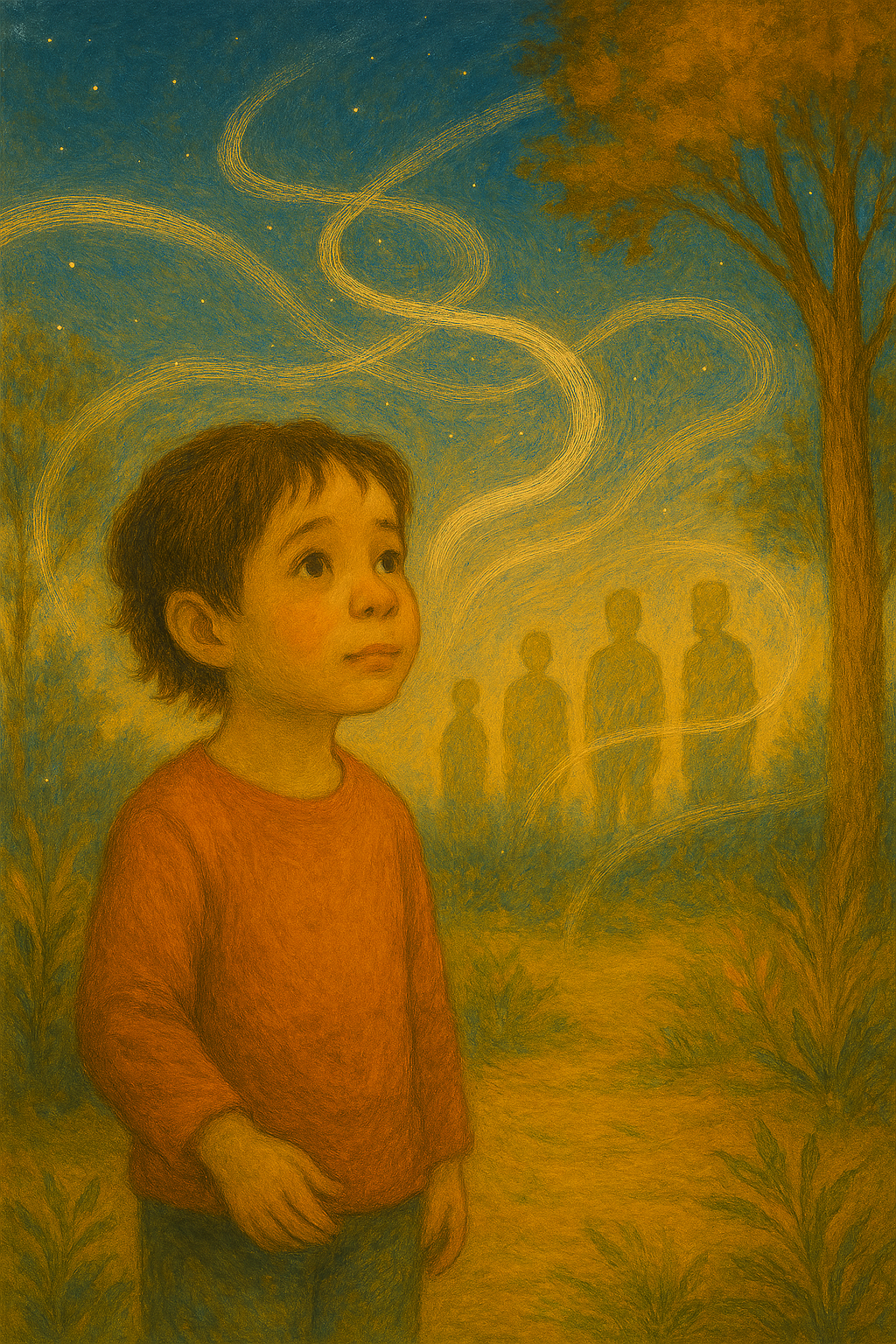
A Child Is Born
A child enters the world with no say in anything that shapes its earliest moments. Not its genetics. Not its health. Not its parents, its home, its culture, or the beliefs it will be taught.
This child doesn’t choose the weather outside its door, the size of its dwelling, the food it eats, or the stories older humans will pass down. It simply arrives—open, curious, and ready to absorb whatever world it lands in.
What If This Child Lived in Total Isolation?
Imagine this child is born into a remote tribe untouched by outside influence. No books. No missionaries. No exposure to Jesus, Buddha, Muhammad, Moses, Abraham, Confucius, or any major religious figure.
This tribe has never heard the words God, Allah, Brahman, Bodhisattva, or Tao. Their language may not even contain a concept that maps cleanly to “religion” as we know it.
One day, when the child is five or six, it asks the most human question of all:
“Where did I come from?”
One of its guardians answer:
“You were created by your birth mother and father. They were created by their parents. And their parents were created by theirs. This chain goes back as far as our tribe has recorded. At some point, all of us are connected.”
Up to this point, nearly every major religion would nod in agreement.
Where Beliefs Begin to Diverge
The next question, “Where did humans come from?”—is where paths split.
- Many religious traditions trace humanity back to a divine creator or ancestral figure: Adam, Manu, Buddha, and others.
- Science offers evolution: billions of years of change, adaptation, and emergence.
- Some blend the two, suggesting evolution may be part of a divine plan.
- Others propose entirely different ideas: intelligent life seeding humanity, or the universe functioning like a vast simulation.
Across time and cultures, humans have tried to explain existence in ways that reflect their fears, values, and hopes. Every story is an attempt to bring order to chaos and meaning to life.
But what about our remote tribe? What if their origin story looks nothing like any belief system we know?
Should they be punished for not believing something they’ve never heard of? How could they possibly adopt a worldview they’ve never encountered?
This Is Where WEligion Begins
A child is born into a tribe called Super WEgo.
From the start, this child learns:
- You are a unique being with your own genetics, experiences, and perspective.
- You are not alone. Billions of other humans are also navigating life with their own unique combinations of nature and nurture.
- You are connected—through ancestry, shared DNA, shared energy, and shared existence.
- You belong to a larger “WE.” Your life is intertwined with others, past and present.
From this foundation, the child develops gratitude for its origins and awareness of its place in the world. As it grows, it discovers purpose: to contribute to the human experience in a positive, peaceful way with every thought, action, and endeavor.
What the child chooses to believe beyond that—about the afterlife, the universe, or spiritual meaning—is open. It may stay with its tribe’s teachings. It may explore other religions. It may blend ideas or form new ones.
Because the real question is not what we believe happens to us after we die. It’s how we treat each other while we’re alive on this chaotic, beautiful planet we SHARE.
The Heart of WEligion
We know we are connected. We know we share DNA across generations. We know our bodies emit energy that interacts with the world around us.
When the child eventually dies, it may believe its energy returns to the universe, or it may embrace another tradition entirely.
But the belief that matters most is this:
We are here together. Right now. And that energy “WE” have is worth honoring.
If this message resonates with you—if you believe in connection, shared humanity, and the power of becoming the best version of yourself—then you’re already aligned with the mission of Super WEgo. We’re building a community centered on self‑awareness, compassion, and collective growth.
Subscribe to stay connected, explore new ideas, and join a movement focused on elevating the human experience—one WEgo at a time.
Stories Define Our Existence
When a child asks, “Where did I come from?” the answer becomes their first map of meaning. We inherit stories, love, and suffering—and with them the responsibility to choose how we live with what we were given.
Quick takeaway: stories orient us, but they don’t always teach us how to heal, grow, or act with compassion.
Why Origin Stories Matter
What they do well:
- Explain how we fit into the world.
- Express a culture’s values and fears.
- Bind people through shared meaning.
Where they fall short:
Origin stories can comfort and divide. They rarely show us how to meet pain, transform inner habits, or practice compassion across differences. WEligion begins here—not to replace existing faiths, but to offer a practical, inclusive framework that centers connection, inner work, and shared responsibility.
A Story to Connect Beyond the Tribe
This is one ordinary day in the life of Wego, who grew up in the Super WEgo community. The day is a template you can try in your life—small practices that turn private growth into public good.
Wego wakes before the alarm, not because the day demands it but because the habit has become a small kindness to themselves. The apartment is quiet in that way cities are before they fully wake. Distant traffic, the hum of a refrigerator, and the neighbor’s kettle beginning to hiss through a thin wall. Wego reaches for a journal, breathes three slow rounds, and lets the breath do what words cannot: settle the body, slow the mind, make room and be present.
The Morning Pause is not a ritual of perfection; it is a practical promise. Wego inhales for four counts, holds for one, exhales for six, and repeats until the shoulders unclench. A quick body scan follows—jaw, neck, chest, belly—then a single word surfaces in their mind: unease. Wego writes it down and sets a simple intention for the day: “listen first.” The intention is small enough to remember and large enough to change how the day unfolds.
Standing outside, Wego admires the maple tree’s leaves that are still wet from last night’s rain. Wego names one thing to be grateful for. It could be the smell of coffee from the corner shop, a neighbor who always returns a borrowed tool, or the fact of simple waking and being alive. This gratitude is not a performance but a hinge. It tilts the day toward attention.
At the nonprofit where Wego works, the morning arrives in the form of emails and a voicemail from a client who has just lost a job. The old reflex—fix it, solve it, make it right—rises like a tide. Wego pauses. The practice of inquiry is simple and immediate: what am I feeling? what story am I telling? The answers are honest: frustration and the story that they must solve this now. Naming the feelings softens the urgency. Wego listens. They offer a referral to a job resource, a promise to follow up, and, later, a small, practical gesture: two grocery bags in the trunk, posted to the neighborhood group with a line that reads, “If anyone needs them today, I’m nearby.” The post is not a sermon; it is a model—compassion as habit, not heroism.
Midday arrives with a two‑minute check‑in. Wego closes their eyes at the desk, notices tension in the shoulders, breathes, and resets the intention. At lunch, they share a three‑minute breath technique with a coworker—something borrowed from a visiting teacher last month—and watch the way a room softens when people breathe together. Later, Wego records a one‑minute audio for the Super WEgo feed: a guided micro‑practice and a prompt—who did you listen to today?—a small nudge to translate inner attention into outward care.
In the afternoon, worry arrives in the form of a text: Mr. Morgan, the elderly neighbor, missed his medication pickup. Wego feels the familiar inner tightening and concern. They follow the four steps WEligion teaches: acknowledge, name, act, reflect. First, they sit with the worry for a breath and resist the urge to panic. Naming it—concern—makes it manageable. Acting is practical: a call to the pharmacy, a walk across the block, and then to Mr. Morgan's. On the walk home, Wego reflects and realizes the pattern of suffering: they have been the default helper for too long. Reflection births a plan: recruit a small rotation so care is shared and sustainable.
That evening the community gathers in the center down the street. The Circle of Witness is not a performance of vulnerability but a disciplined practice. Wego opens with three breaths and a reading of the Code: speak for yourself, listen without fixing, offer one small action if you can. People speak in turns—a parent worried about a teen’s isolation, a barista celebrating a small kindness, a retiree grieving a friend and Wego's concern for Mr. Morgan. Wego listens and models inquiry, inviting the group to name the stories that amplify pain. The circle’s power is in converting insight into action: someone volunteers to host a teen game night, another offers to bring soup, and a rotation is created for Mr. Morgan. Before leaving, the group stands in silence for a minute. The silence is not empty; it is a shared breath that honors what cannot be fixed in a single evening and the energy that exists between us.
Wego’s spiritual life is not a set of doctrines but a posture: awe, ethics, and mystery. On the walk home, the city lights blur into a soft constellation, and Wego feels both small and connected. There is no tidy answer for why people suffer, only practices that help them meet suffering without being consumed by it. Wego sits by the window later, watches a plane cross the sky, and allows the not‑knowing to settle like a cool hand on the forehead. This is the spiritual thread of WEligion—an invitation to reverence without certainty.
Before bed, Wego performs the Evening Review: one thing done well and one thing to try differently. Tonight’s entry reads: “Did well: listened without fixing. Try differently: ask for help sooner.” They send a short message to the volunteer rotation, “I can take Wednesday pickups for Mr. Morgan”—and feel the small, steady satisfaction of a promise kept. Sleep is treated as integration, not escape: three slow breaths, a phrase of gratitude, and the humility to accept that tomorrow will bring new challenges and new chances to practice.
The day is ordinary—work, errands, neighbors, dinner, sleep—but ordinary does not mean trivial. The difference is practice. Breath, inquiry, gratitude, service, ritual, and reflection are not exotic; they are repeatable habits that reshape how Wego meets suffering and how the neighborhood responds. Suffering becomes a teacher when it is acknowledged rather than denied; attention becomes a muscle when it is exercised daily; community becomes resilient when care is organized rather than improvised.
If you read Wego’s day and think, “I could try that,” then start with one small thing: three breaths, name one feeling, set one intention for the next hour. Do it now. Notice how the world shifts—not because the world changes, but because you do. Over weeks and months, those tiny shifts compound into a life that honors both your uniqueness and your belonging. That is WEligion in practice: a way of living that wakes you up, heals you slowly, and turns private growth into public good—one breath, one question, one small act of care at a time.